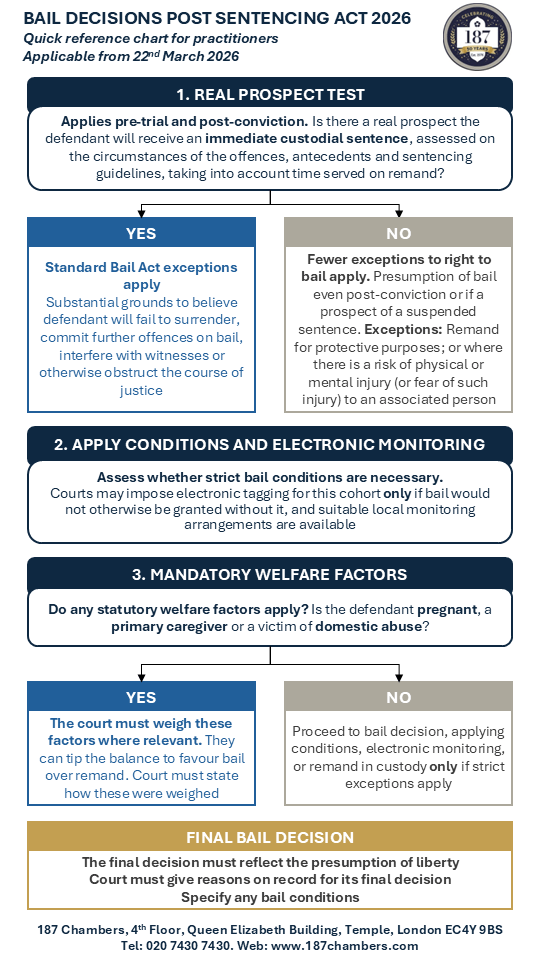
Key Changes to Bail (Sentencing Act 2026, Part 3):
To align with the sentencing provisions and manage the prison remand population, Part 3 of the Act fundamentally overhauls the bail decision-making process. Section 44 of the SA 2026 in particular makes various amendments to sections 2 to 3AC and Parts 1 and 1A of Schedule 1 of the Bail Act 1976.
- The “Immediate Custody” Threshold: The standard exceptions to the right to bail have been narrowed. Fewer exceptions will now apply if there is no real prospect of a sentence of immediate custody, even if there is a realistic prospect the defendant will receive a suspended sentence (s. 44(8)(a) SA 2026, amending the Bail Act).
- Post-Conviction Application: Previously, the full range of Bail Act exceptions applied once a defendant was convicted. The Act now extends the more limited “no real prospect of immediate custody” exceptions to convicted defendants who are awaiting sentence (amendments in s. 44(8) and (9) SA 2026).
- Expanded Use of Electronic Monitoring: Courts are now empowered to impose electronic tagging on adult defendants (in non-extradition proceedings), who have no real prospect of an immediate custodial sentence, but who do face a real prospect of a suspended sentence. For an either-way or indictable-only offence, this can be imposed if suitable local monitoring arrangements are available, and either:
- There are substantial grounds to believe the defendant would fail to surrender, commit further offences, or interfere with justice; or
- Bail would not otherwise be granted without the monitoring requirement. (s. 44(4) SA 2026, inserting s. 3AAB into the Bail Act 1976)
- Mandatory Statutory Welfare Factors: The Act expressly inserts new welfare considerations into the Bail Act 1976; the court shall have regard to whether a defendant is pregnant, a primary caregiver, or a victim of domestic abuse, where these factors are relevant to the decision to grant bail. (s.44(8)(b) SA 2026).
Important Caveats to the Presumption of Bail
The presumption of liberty is not absolute. Remand in custody is still permitted for a defendant’s own protection (Sch 1, Pt 1, para 3 Bail Act 1976). Furthermore, while the “no real prospect of immediate custody” test prevents remand under the standard exceptions (such as failure to surrender or further offending), the court retains a specific power to remand if there are substantial grounds to believe the defendant would cause physical or mental injury (or fear of such injury) to a person who is associated with the defendant (Sch 1, Pt 1, para 2ZA Bail Act 1976).
The definition of an “associated person” is drawn from section 62 of the Family Law Act 1996. It is cast very widely and includes current or former spouses and civil partners, cohabitants, relatives, people who share a child, people who live in the same household (excluding lodgers or tenants), and crucially, people who have or had an “intimate personal relationship” of significant duration
When do the changes take effect?
- Sentencing Provisions: The new presumption to suspend short sentences and the extended three-year maximum term apply strictly to defendants convicted on or after 22 March 2026.
- Bail Provisions: The bail reforms apply broadly across the criminal justice process. They govern both unconvicted defendants at the pre-trial stage and convicted defendants who are awaiting sentence.
New Bail Decisions Flow Chart To assist busy practitioners with applying these amended Bail Act provisions in real-time, please refer to the accompanying flow chart for a step-by-step practical guide.
Written by Greg Unwin and Sarah Karimi.
Click here to download flowchart – PDF
Click here to download flowchart – PNG